
The MountResilience project held its latest Replication Lab in Regione Piemonte, Northern Italy, one of the project’s six demonstrator regions. Representatives from the four replicator regions, Catalonia in Spain, Primorje-Gorski Kotar County in Croatia, Friuli Venezia Giulia in Italy, and the Subcarpathian Region in Poland, joined the Piedmont team for three days of presentations, field visits and collaborative sessions focused on water resources, irrigation and drought management.
Led by INOVA+, the visit gave the replicator partners the opportunity to examine how Piedmont is responding to water scarcity and identify tools, methods and information that may be relevant to the preparation of the Replication Plan for each region.
The programme began with an introduction to Piemonte’s agricultural landscape and the growing pressure on its water resources. Northern Piemonte is one of Italy’s main rice producing areas, while the province of Cuneo is characterised by maize cultivation, permanent grasslands and livestock farming. All these activities depend heavily on irrigation.
Stefania Tamea, Principal Investigator for MountResilience at Politecnico di Torino, presented the context of the Northern Piemonte pilot area, highlighting the severe drought of 2022, when exceptionally high temperatures and low precipitation reduced water availability and led to conflicts over its allocation. This regional context framed the tools, governance arrangements, and agricultural practices explored during the visit.
Participants were introduced to two decision support tools being developed by the demonstrator. One simulates irrigation systems and water availability, while the other supports farmers in deciding when and where irrigation is needed.
Irrigation governance was also discussed. Silvia Mirate from the University of Turin presented a legal study on options for simplifying coordination across Piedmont’s approximately 740 first level irrigation consortia, organised into 36 districts, allowing replicators to examine how governance questions are being addressed alongside technical water management solutions.
On the second day, participants travelled to the province of Cuneo to see the irrigation system in operation. First, they visited the Beinette Lake, where spring water is distributed through a gravity fed network serving several irrigation consortia and supporting agriculture, aquaculture and hydropower production.
The visit continued in the municipality of Pogliola, where a canal first constructed in the thirteenth century remains in use. Here, traditional surface irrigation operates alongside monitoring equipment used to measure water flows and assess irrigation efficiency.
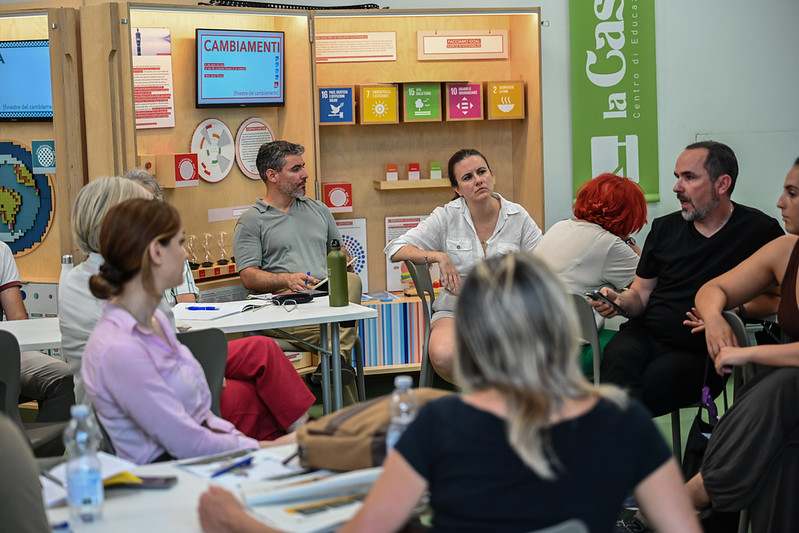
The day concluded with a workshop led by Armando Alves from INOVA+, during which each replicator presented its current situation, the challenge being addressed and its proposed solution. Feedback from the INOVA+ team and the other replicators supported mutual learning and the continued development of their Replication Plans.
The final day focused on the Cavour Canal and the irrigation system serving Piemonte’s rice growing areas. Participants learned how daily hydrometric data are used to monitor and redistribute water across irrigation districts, balancing agricultural needs with downstream water supply and hydropower production. During drought periods, distribution can be adjusted to support the areas experiencing the greatest shortages.
At a rice farm in Olcenengo, participants learned how precision agriculture is being used in flooded rice cultivation. Sensors, connected machinery and variable rate fertilisation help monitor crop performance and improve resource use. This year, the farm has received around 40 per cent less irrigation water than normal and is gradually shifting towards more water efficient cultivation practices.
Over the three days, the four replicator regions examined how Piemonte combines monitoring, decision support tools, irrigation governance and agricultural practices to respond to water scarcity. The RepLab provided information to help the replicators better understand the adaptation measures implemented in Piedmont and assess how these tools and approaches could be applied and adapted to their own regional contexts.