
In the heart of the Swiss Alps, water has always shaped life, landscapes, and livelihoods. But as climate change accelerates, mountain regions like Valais are facing a new reality: water availability is becoming increasingly variable, contested, and difficult to anticipate.
Against this backdrop, the MountResilience consortium gathered online for the 7th Inter-regional Cross-Pollination (ICP) session, hosted by the Swiss demonstrator team (EPFL+ECAL Lab, EPFL, BlueArk, RIVER LAB, Apptitude SA)
A complex watershed, a simple question
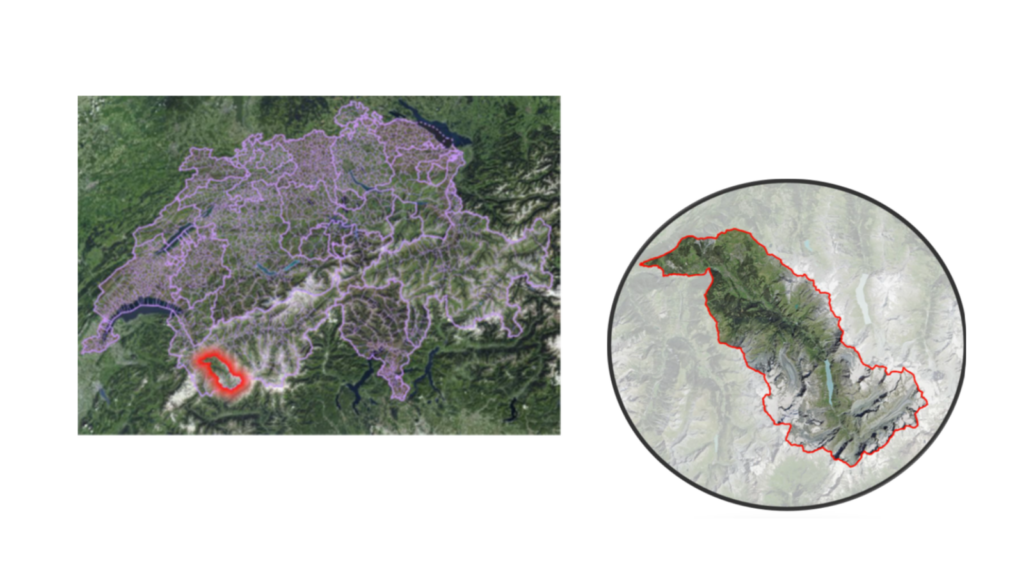
The ICP opened with an overview of the Val de Bagnes demonstrator by Roderick Constantin
from BlueArk, an alpine territory defined by steep topography, strong seasonal contrasts, and highly interconnected water networks. Here, water is used simultaneously for drinking supplies, agriculture and irrigation, tourism and snowmaking, ecosystem health, and hydropower production.
In such a context, decision-making is rarely straightforward. Data exists, but it is often fragmented, difficult to interpret, or inaccessible to non-experts. As the Swiss team emphasised, discussions too often rely on perception rather than shared, measurable facts. This led to a key reframing that resonated strongly with participants: The question is no longer “Is there water?”, but “Is there enough water, in the right place, at the right time?”.
Measuring what matters: from monitoring to meaning
Rather than multiplying sensors and data streams, the Valais approach focuses on useful monitoring. The system presented during the session is built on three guiding principles:
- Measure less, but measure well, using robust sensors that provide continuous data.
- Connect resources to demand, avoiding isolated numbers and always adding context.
- Produce understandable indicators, usable by non-experts and acceptable in political and social settings.
Concrete examples illustrate this logic in action. Instead of displaying the raw water volume of the Lac de Louvie, the system compares stored water with current demand, translating the situation into intuitive states such as ‘’comfortable’’, ‘’under stress’’, or ‘’critical’’. Similar indicators help anticipate irrigation needs through soil moisture monitoring or assess stress levels in drinking water systems and irrigation zones.
By shifting from raw data to decision-oriented indicators, stakeholders can move from reactive crisis management to anticipation and dialogue.
Designing engagement: when data meets people
The second part of the ICP explored how these indicators become meaningful beyond technical circles. Led by the EPFL+ECAL Lab team, the session highlighted a Research through Design approach combining field observations, participatory workshops, and user testing with farmers, public authorities, and citizens.
This process resulted in an experimental digital tool designed to foster understanding and engagement. Key features include:
- Clear, relative indicators that provide an immediate overview of the water situation.
- Map-based visualisations anchoring data in familiar places and infrastructures.
- Observations, alerts, and a Nature-based Solutions catalogue, linking detected issues to possible actions.
User testing revealed strong emotional and cognitive engagement. Participants found the tool intuitive, aesthetically appealing, and informative. Most importantly, interaction with the prototype led to a measurable increase in users’ sense of agency: after testing, participants felt more capable of acting for the resilience of their region.
A crucial lesson: engagement needs governance
The session also surfaced an essential insight for all MountResilience partners. While users are eager to contribute observations and engage with water-related information, they clearly expressed the need for institutional accountability.
Participants wanted reassurance that their input would feed into real decision-making processes, supported by clear moderation and visible governance. Without this, engagement risks turning into frustration. As discussions showed, trust is built not only through good design and data, but through transparent roles and responsibilities between citizens, experts, and public authorities.
From Valais to other regions
The ICP concluded with a roundtable discussion reflecting on implementation challenges, lessons learned, and transferability. The consensus was clear: monitoring systems should not be an end in themselves, but part of broader decision-support ecosystems that connect science, design, and governance.
The Valais experience offers valuable inspiration for other mountain regions facing similar water challenges. By combining robust monitoring, meaningful indicators, and user-centred design – while acknowledging the importance of governance – MountResilience continues to explore how communities can better anticipate, understand, and collectively respond to climate risks.